

Scientific evidence
ExoGain evidence: growth factor ELISA, exosome NTA and safety
ExoGain’s scientific documentation focuses on analytical evaluation of its biological composition.
01 · Growth factor analysis — ELISA
Growth factor concentration
Enzyme-Linked Immunosorbent Assay is used to quantify selected proteins and growth factors. Reported values for PDGF, VEGF, bFGF, TGF-β and EGF:
PDGF · axis 0–100,000 pg/ml
VEGF, bFGF, TGF-β, EGF · axis 0–4,000 pg/ml
View the data as a table
| Growth factor | Concentration | Unit | Associated role |
|---|---|---|---|
| PDGF | 99,443.75 | pg/ml | Fibroblast recruitment, extracellular matrix formation |
| VEGF | 3,899 | pg/ml | Angiogenesis, microvascular development |
| bFGF | 2,793 | pg/ml | Cell proliferation and migration, hair follicle biology |
| TGF-β | 1,732.50 | pg/ml | Collagen production, matrix remodelling |
| EGF | 550 | pg/ml | Epithelial proliferation, skin repair |
02 · Nanoparticle Tracking Analysis
Particle concentration & size
NTA is used to characterise nanoparticle concentration and size distribution in the final preparation.
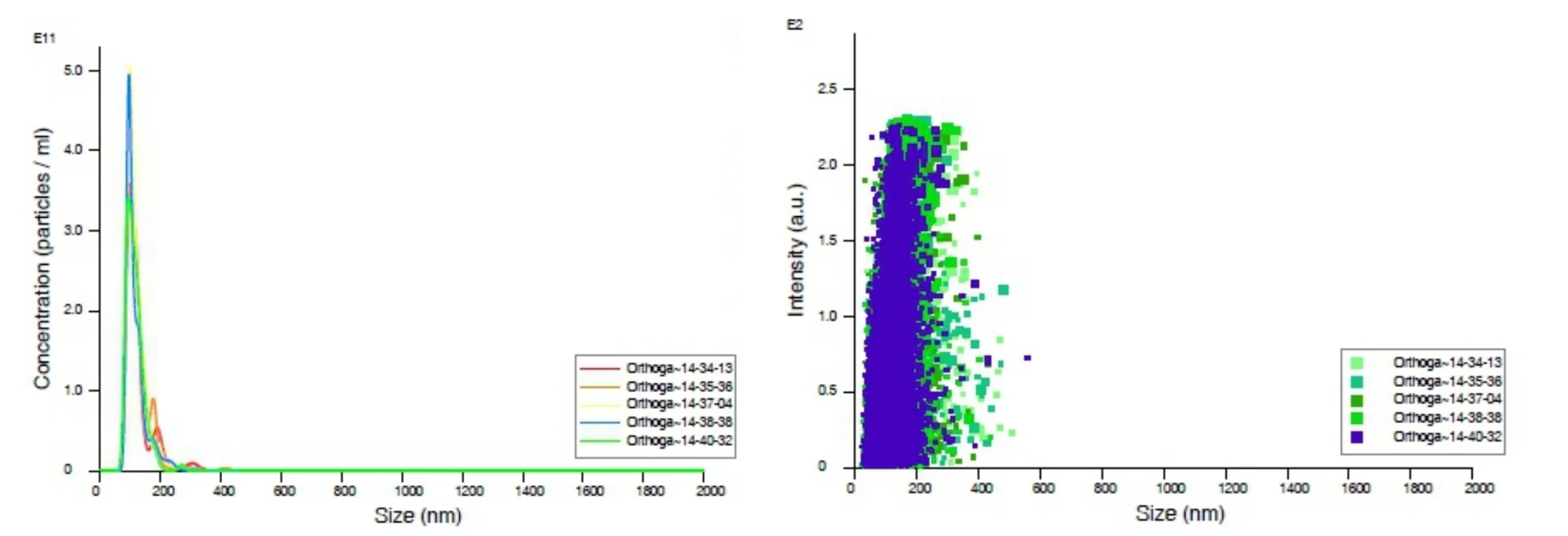
Particle concentration
Reported nanoparticle concentration in the final preparation.
Size distribution
Of detected particles between 30–150 nm.
Quantified by ELISA
PDGF, VEGF, bFGF, TGF-β and EGF, alongside the particle data.
Note: NTA provides information about the nanoparticle population. It does not independently establish exosome identity or purity. The full NTA report is available to healthcare professionals on request.
03 · Clinical evaluation
Ongoing clinical study
Recruiting
ExoGain is being evaluated in a prospective clinical study assessing hair growth and hair quality outcomes. Published clinical findings will be shared here when available.
- Study design
- Prospective, open-label, single-arm, multi-centre
- Study centres
- 3 centres across India
- Follow-up
- 16 weeks per subject
- Conduct
- Per ICH-GCP, the Declaration of Helsinki and ICMR ethical guidelines
04 · Scientific documentation
Available to healthcare professionals:
Our commitment: responsible scientific communication, analytical transparency and continued clinical evaluation.
Safety
Patient-specific. Autologous. Professionally prepared.
ExoGain is designed as an autologous preparation system using the individual patient’s own blood-derived material.
Autologous preparation
The preparation uses patient-specific biological material rather than donor-derived material.
Single-patient use
The kit is designed for single-patient preparation. Disposable components must not be reused or shared.
Controlled preparation
The preparation process follows a defined sequence of blood collection, processing, separation and filtration.
Professional administration
ExoGain must be prepared and administered by appropriately qualified healthcare professionals trained in the protocol.
Patient assessment
Before treatment, clinicians should evaluate:
- Medical and medication history
- Relevant bleeding or clotting disorders
- Active infection
- Skin or scalp condition
- Suitability for the intended procedure
- Any contraindications described in the IFU
Safety considerations
As with venepuncture and injection procedures, potential adverse events may include temporary pain, tenderness, bruising, redness, swelling or infection. Specific risks depend on the administration technique, treatment site and patient characteristics.
Regulatory information: Class A medical device, Mfg. licence no. MFG/MD/2025/000469. For complete contraindications, precautions and warnings, refer to the authorised Instructions for Use. Report any suspected adverse event to info@exogain.in.
For dermatologists · aesthetic physicians · plastic & reconstructive surgeons
Advancing the science of regenerative aesthetics.
ExoGain brings together exosome-enriched biological components, concentrated growth factors and a patient-specific preparation approach — for healthcare professionals exploring the science of skin, hair and tissue regeneration.